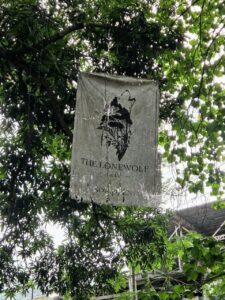
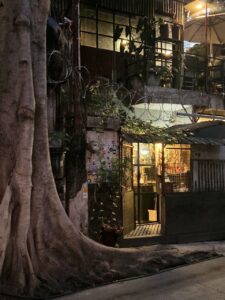
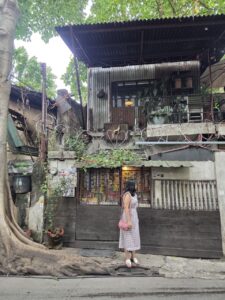
From the outside, Lonewolf looked like a small sari-sari store tucked beneath an enormous tree in Cagayan de Oro. If you were just passing by exploring with no particular destination in mind, you probably wouldn’t guess that there was a coffee shop behind that unassuming door.
Fortunately, my friends know about it.
Kesiah and the others had been to Cagayan de Oro too many times before, and they thought us first timers we might enjoy the café because it looked aesthetically pleasing. We were so determined to visit, so much so that we decided to commute. None of us spoke Bisaya and so we knew we’d have to figure things out as we went and thankfully, we managed.
I already expected a pretty café behind that unassuming door. What I didn’t expect was to find myself standing inside what felt like a different era.
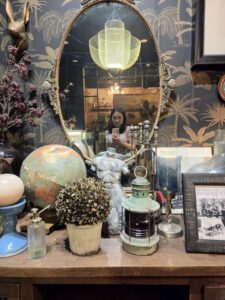
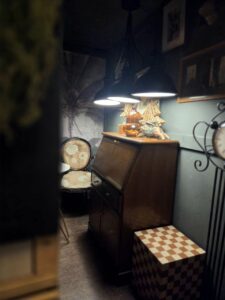
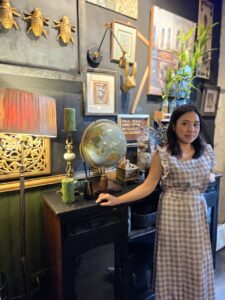
The interior had an old-world quality to it: dark walls, antique furniture, framed artwork, an old television, a globe, and little objects that looked as though they had been collected over many years. There was something almost Great Gatsby-esque about the atmosphere, although I wouldn’t know how to classify its style properly. Vintage? Certainly. A little eccentric, perhaps? The sort of place where you half expected someone to emerge from behind a cabinet carrying a secret.
And then there was the smell.
I couldn’t identify the fragrance of the diffuser, but it reminded me of the long pink incense sticks used in Chinese temples. You know the kind that makes you think someone is trying to drive away evil spirits? That one. Which was rather ironic, considering what the smell reminded me of. But I’ll get to that.
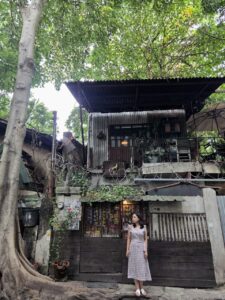
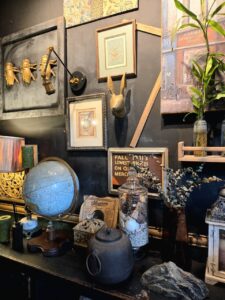
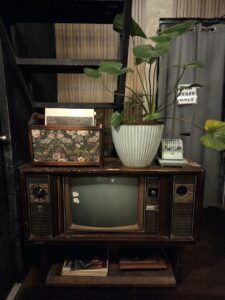
A world behind the walls
The café had a lot to look at, but there was one particular corner that caught my attention. It was a small room, almost like a cupboard tucked beneath a staircase, filled with old furniture and objects that seemed to have stories of their own.
That was when I thought of Emil.
Emil is a character in my unfinished novel, Pananauli. His world includes an antique shop, and I have always imagined it filled with cabinets displaying all sorts of old things. The café’s little room felt like a glimpse of what I had been trying to picture in my head.
Emil’s world could look like this. I remember looking around and thinking, “Ganito pala ang mundo niya.”
It was a strange feeling, seeing something that existed only in my imagination take on a physical form. Of course, the café wasn’t Emil’s antique shop. There was no rotary phone sitting on the counter, waiting for someone to answer it. But the old furniture, the cabinets, and the atmosphere were close enough for my mind to fill in the gaps. I could almost imagine Emil belonging there.
And then I began imagining Arrie, too.
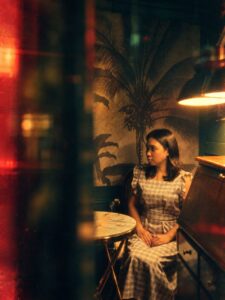
In the beginning of Pananauli, Arrie and Emil have an enemies-to-lovers sort of relationship. Their story is complicated, and the world they eventually choose to live in is far from where they started. But in that little room, I imagined Arrie at a point when she had already begun to accept that she might be stuck in an unfamiliar world for a while. She has a little hope left, perhaps, but she doesn’t know where to look for it.
I took a photograph of myself sitting in that corner. Looking back, I think I was imagining myself as Arrie. It wasn’t a scene I had planned to write. I wasn’t suddenly coming up with dialogues or figuring out the missing chapters of my novel. I was simply imagining what it might feel like to be her, sitting in a world she hadn’t chosen, trying to make sense of the life she might have to live. And for a moment, the café gave me somewhere to put that feeling.
Perhaps that’s what happens when you spend enough time with a fictional world. You begin to recognize pieces of it in places you visit, objects you encounter, and moments you never expected to have. You don’t necessarily have to write them down immediately. Sometimes, you just want to stand there and think, Oh. So this is what it could look like.
The incense-like fragrance even reminded me of the first two Panglawan books, Marahuyo and Karayama, where incense is used to ward off Ian (a tamawo) and Kovi (a half-kapre). Apparently, my brain had decided that the café was an intersection of my fictional universes. All I needed was a character walking out of the vintage television.
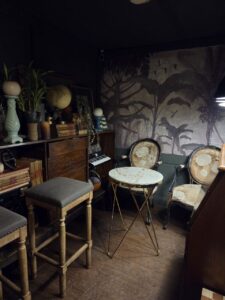
Coffee, pasta, and the five senses
Here’s something I found amusing: this is the only coffee shop I’ve visited that I remember not smelling like coffee.
Instead, I remember that incense-like fragrance, the old furniture, the warm lighting, and the music playing somewhere in the background. I couldn’t identify its genre, but it suited the space so well that I felt as though Emil might be somewhere behind the walls. I have no idea what kind of music belongs in a world like his. I only know that whatever was playing made it easier to imagine him there.
The café was an experience for all five senses, I suppose. The visuals were beautiful, the scent was distinctive, the music gave the place its atmosphere, and the food and drinks gave me something to enjoy beyond the photographs.
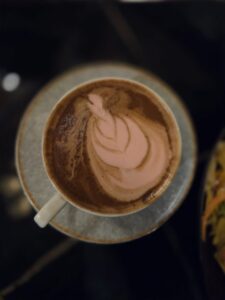
On my first visit, I ordered a rose latte. I usually order caramel macchiato (though I have been leaning more towards Spanish lattes recently), and when I’m at a specialty coffee shop, I would ask for a Yirgacheffe pour-over whenever it’s available. This time, I wanted to try something unfamiliar. I’ve had ube and durian lattes before, so a rose latte seemed like a reasonable next experiment. It was thick and creamy, with a gentle floral note. I enjoyed it enough to order it again when we returned.
But I deliberately tried not to fall in love with it.
I knew I lived far away and might not get to have it again anytime soon, if I ever returned to Cagayan de Oro. So I allowed myself to enjoy it while I could. And I’ve had similar experiences with durian and ube lattes. Because sometimes, you try something unfamiliar, enjoy it, and carry the memory of it with you long after the drink is gone. I don’t need to make a promise to return to a place just because I enjoyed something there.
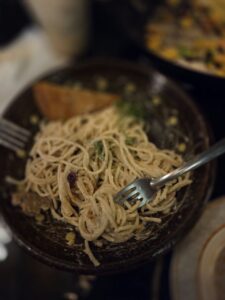
The food was generous, too. I had carbonara on our first visit and truffle pasta on the second, along with nachos. Both pasta dishes were rich and creamy, and the servings were generous enough to share. Or not share, if you preferred to finish them yourself hahaha. I could have managed.
The carbonara was a little nakakaumay for me, especially since I make mine with egg yolks rather than cream. The truffle pasta had a distinct earthy, mushroomy flavor. Both were enjoyable, though I suspect I would have appreciated them even more with a tall, icy glass of Coke. Some things are simply better with Coke. I will stand by this opinion.
We visited the café twice. The first time, I was excited and had the energy to explore, take photos, and imagine all sorts of things. The second time, we had just come from Camiguin (more of this on the next blog, I promise!), and I was exhausted. We returned because we wanted our other friends, especially Abi, to experience the place, too. The café was still lovely, but I didn’t have the same energy for it. I was tired, and I wanted to go home. It was a reminder that even a beautiful place can only be experienced through the person you are when you arrive. Sometimes you’re curious and full of ideas. Sometimes you’re just trying to get through the day. Both versions of me visited Lonewolf. Only one had the energy to pretend she was living in a Wong Kar Wai film.
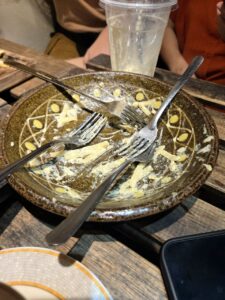
An ordinary saturday at Lonewolf
If Lonewolf were in my neighborhood, I think it would become one of my go-to cafés. Not necessarily for writing. I already have a coffee shop I associate with work and creative writing. Lonewolf would serve a different purpose.
I imagine spending a lazy Saturday afternoon there, ordering a rose latte and sitting in that little corner to watch an episode or two of a Chinese drama. Or I could sit at the al fresco dining area on the second floor, listening to Jung Yong Hwa’s Almost Forever through my earbuds while counting the red cars passing by. I might bring a book. I might play Love and Deepspace and swoon over Sylus and Caleb. Or I might just simply sit in a quiet corner and do nothing at all. And I wouldn’t need to write a single word.
There’s something comforting about imagining an ordinary afternoon in a place you have only visited twice. Not a special occasion or a carefully planned trip or a day when you have to make the most of every minute. Just an afternoon in which you can enjoy your coffee, listen to music, and let the world move around you. I think that’s what I would like about having Lonewolf nearby. It would be a place where I could enjoy my own company without feeling the need to turn the experience into something productive.
Of course, I found myself imagining a fictional world there anyway. I couldn’t help it. But that doesn’t mean every visit would have to become material for a story. Sometimes, I’d just want my rose latte.
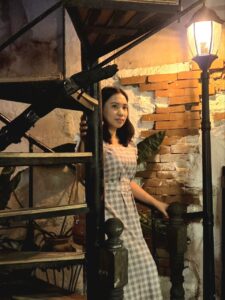
A place I found far from home
What made Lonewolf stay in my memory wasn’t just its interior or the food and coffee. It was the combination of everything: the old furniture, the unfamiliar fragrance, the music, the little room that reminded me of Emil, and the fact that I found all of it in a place far from home.
Cagayan de Oro isn’t somewhere I visited regularly. Getting to the café meant flying on a plane and commuting with my friends and venturing into a city I was still getting to know. It was part of a trip I hadn’t planned around coffee shops or fictional characters. And yet, there I was, sitting in a little room, imagining what my unfinished novel might look like if it existed outside my head.
I left the café wanting to finish Pananauli. Not because I had suddenly figured out the missing pieces, but because I had seen a glimpse of the world I wanted to bring to life. The problem remained the same: I knew the conclusion, but I still didn’t know how to get there. Inspiration, apparently, doesn’t come with a map.
It has been ten days and I still think about that little room sometimes and wonder what it would be like to sit there again, with a rose latte and no particular plans for the afternoon. Perhaps I would imagine another scene. Perhaps I would read a book or watch a Chinese drama. Perhaps I would do nothing at all.
I don’t know when I’ll return to Lonewolf, or if I will. But I’m glad I went. Because for a little while, I got to see a world I had been imagining for my story. I got to sit where I thought Arrie might sit, surrounded by objects that reminded me of Emil’s world. I got to enjoy a drink I might not have again soon, and imagine the ordinary afternoons I could have spent there if the café had been closer to home.
The experience didn’t finish my story for me. It didn’t tell me how to return to the world of Pananauli or how to write the way toward its conclusion. But it reminded me that the world was still there. And perhaps, for now, that is enough. Somewhere in my head, Emil’s antique shop is still waiting. Arrie is still trying to find her way. And I am still figuring out how to get back to them. Maybe one day, I’ll find the way.
Until then, I’ll keep the rose latte, the music, the smell of incense, and that little room in Cagayan de Oro as reminders of what my imagination can find when I least expect it.