Spoilers ahead for Forgotten Island. If you haven’t seen it yet, watch it first and come back.
I have no idea what to expect from Forgotten Island. The only things I knew before watching it were that Lea Salonga, Liza Soberano, and Dolly de Leon lent their voices to important characters, which was enough to make me curious. I hadn’t really researched the movie beforehand, and when Kim invited me to watch it, my only other point of recognition was that it was apparently THAT movie some people online had been arguing about, whether it should even be called a Filipino film because not everyone involved in making it was Filipino.
But honestly, I didn’t go to the cinema thinking about that debate. I went because there were mythical creatures. As someone who grew up hearing stories about Filipino folklore, and an author who has written books involving hot and spicy PH mythical creatures, that was enough to get me interested.
Forgotten Island follows Jo and Raissa, two childhood best friends who have grown up together dreaming of Nakali, a mysterious island Jo’s Lola Fatima had always told them about. So when the portal to Nakali finally appears right in front of them, Jo immediately says the phrase they have apparently used throughout their childhood: “Tayo na.”
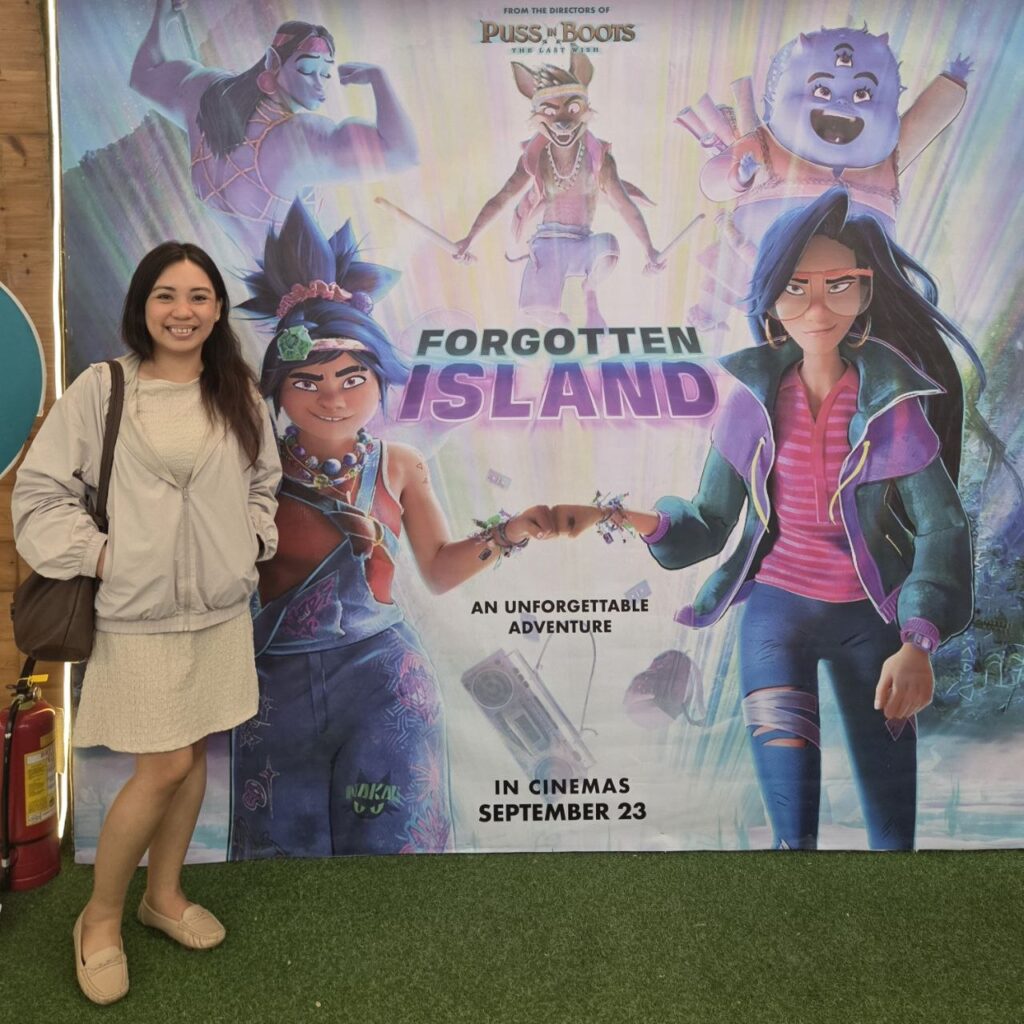
At first, I thought the movie might be an LGBTQ movie. 😂 Not because it actually was (but then, what do I really know?), but because I have watched too many stories about intensely bonded female friendships. I had read Alon and Lila, and the friendship between Jo and Raissa reminded me of that kind of closeness. Eventually, though, I settled into the simpler explanation: they really were just best friends. The familiar kind of best-friend pairing where one is more logical and grounded while the other is more carefree and impulsive.
The movie does a good job establishing that their friendship has history. They wear friendship bracelets and over the years, charms have been added to them, with each charm carrying a memory. One of them is a cassette tape: Jo made Raissa a mixtape by recording songs from the radio through a boombox.
And I repeat: a mixtape recorded from the radio through a boombox.
Because as someone who actually did that as a teenager, I felt personally attacked by nostalgia. 😂
But that little detail did something more important than make me remember the 90s. It made me remember my friends.
I thought about the friendships I had when I was younger: the people I went to Tronix Studio with for pictures, the friends I traded Backstreet Boys and Hanson posters with, and the people I shared my latest obsession with. There were stationery sets and pretty letters and little things that seemed incredibly important at the time. And I still have some of those letters. I don’t have a friendship bracelet like Jo and Raissa’s, but I understand that kind of friendship: the kind where an ordinary object becomes precious simply because you shared the moment attached to it.
And suddenly, Nakali made sense to me in a way I wasn’t expecting.
Not immediately, though. Because when Jo and Raissa first arrived, my reaction was basically, “Okay. We’re in Nakali now. Ano’ng meron dito?” 😂
But as the story unfolded, Nakali became this strange, beautiful version of the Filipino folklore I grew up with. There were kapres, tyanaks, manananggals, batibats, dwendes, and other creatures drawn from the stories I heard as a child. Only these creatures looked… beautiful.
The dwendes were practically cuddly. The tyanak was adorable for most of the movie before eventually becoming frightening, even for a little bit. The merman was, for lack of a better description, extremely metrosexual. And Manang, the manananggal, was so pretty.
Which is funny because that wasn’t how I knew these creatures growing up.
The creatures in the stories I heard as a child were supposed to scare you. Dwendes weren’t cute little forest friends. You were supposed to say “tabi po” when passing by their territory, or risk making them angry. I even remember an accident from when I was little. I had fallen near a coconut tree and twisted my arm. When we went to the manghihilot who was also a mangtatawas, I was told that I had apparently fallen on or disturbed a dwende, and that the dwende had twisted my arm as punishment.
Whether I believed that explanation or not, the story stayed with me.
And that’s what folklore does. It becomes part of the way you understand the world when you’re young.
So it was fascinating to see these familiar creatures transformed into something more inviting. They weren’t necessarily harmless, because their personalities and supernatural nature were still there, but their appearance made Nakali feel less like the frightening world of childhood folklore and more like a place you’d actually want to visit.
And for Jo and Raissa, Nakali isn’t just a magical island. They have dreamed about it since they were children because of the stories Lola Fatima told them. Nakali was their shared childhood dream.
And then real life begins to pull them apart.
Raissa is leaving for California to study. Jo was supposed to go to the United States too when she was younger, but that never happened. She is the one who will be left behind. So when the portal finally appears, Jo doesn’t hesitate.
“Tayo na.”
For her, it isn’t simply an invitation to adventure. It’s a way of holding on to something they have always shared.
But once they are in Nakali, the reality of Raissa’s departure begins to sink in. Jo eventually makes a decision that changes the course of their entire adventure: she hides the portal key so they can’t return home.
At first, I wasn’t particularly fond of Jo’s behavior. Raissa was panicking, and Jo seemed to have absolutely no sense of urgency. Or maybe I’m just older now? 😂 Because as an adult, I could understand Jo’s feelings while still thinking, Girl. What were you thinking?
But the more we learn about her, the more understandable it becomes. Jo doesn’t really have anyone else. After Lola Fatima dies, Raissa is the closest thing she has to family. That doesn’t make what she did right, but it makes it human.
Then comes the cruelest part: Jo’s memory of hiding the key is taken from her. Suddenly, the girls are trapped in Nakali because of a choice Jo made, but neither of them remembers that choice. From there, the movie becomes increasingly interested in the power of memory.
Batibat then begins taking their memories one by one because of a bargain, and those memories aren’t just random pieces of information. They are the history of Jo and Raissa’s relationship: their childhood, their shared experiences, their little rituals, and the things that made them who they are together. The final memory is particularly painful because it takes us all the way back to the beginning of their friendship. At that point, the threat isn’t simply forgetting a happy memory. It is the possibility of losing the person who has been part of your life for as long as you can remember.
Fortunately, the movie had already established how much meaning their friendship bracelets carried. Raissa still has hers, and eventually the bracelet becomes the thing that counters Batibat’s power. And when Batibat realizes that memories are more powerful than she expected, it felt almost like the movie’s version of a Disney True Love’s Kiss.
Except this wasn’t romantic love. It was friendship. And I think that’s what made it work for me. Because Forgotten Island isn’t really saying that memories are important simply because they help us remember things. It’s saying that memories become part of who we are.
“Pics or it didn’t happen” suddenly feels like bullshit.
Don’t get me wrong. Photos are wonderful. I love taking them. But memories don’t live inside photographs. They live inside us. You can lose the picture and still remember how a place felt. Likewise, you can lose the letter and still remember who wrote it. And you can forget the exact conversation and still remember how someone made you feel.
Eventually, those experiences become part of your personality, your choices, and your stories. They change you. And that’s why the ending of Forgotten Island felt so warm to me.
Jo doesn’t simply return home. She grows up. She becomes an author, and the story she writes is based on their adventures in Nakali. The girl who once carried her childhood memories through charms and bracelets eventually grows up to turn those memories into a story.
And somehow, that hit a little too close to home.
Because I also started writing because of the things I obsessed over with my friends. Back then, it was Backstreet Boys and Hanson. I wrote fanfiction at the back of my math notebook. I didn’t know I was beginning a writing journey. I was just a girl who loved stories and wanted to make more of them.
And that’s probably one of the quiet things memories do. They don’t always stay memories. Sometimes they become stories. Sometimes they become the person you eventually become.
Which also brings me back to Singapore. I could lose every photograph I took there tomorrow. The pictures could disappear from my phone, my hard drive, my cloud storage—gone. But I would still have been there. I would still have stood in Marina Bay Sands and experienced a version of a dream I had carried for years. MBS didn’t just give me photographs. It created a version of me who had finally touched one of her dreams. And no deleted photo can undo that.
And this is what I ultimately took away from Forgotten Island. Not that we should hold on to every memory forever, but that we should recognize what those memories have already done to us. The friendships. The places. The silly obsessions. The people we loved. The adventures we thought were ordinary at the time.
They become little pieces of us.
So yes, I would tell you to watch Forgotten Island.
But don’t watch it alone if you can help it. Watch it with your best friend. Watch it with the people who matter to you. Watch it with the people you already have a ridiculous number of memories with. And while you’re watching, make another one.
Because sometimes, memories are the very thing that can save you.